
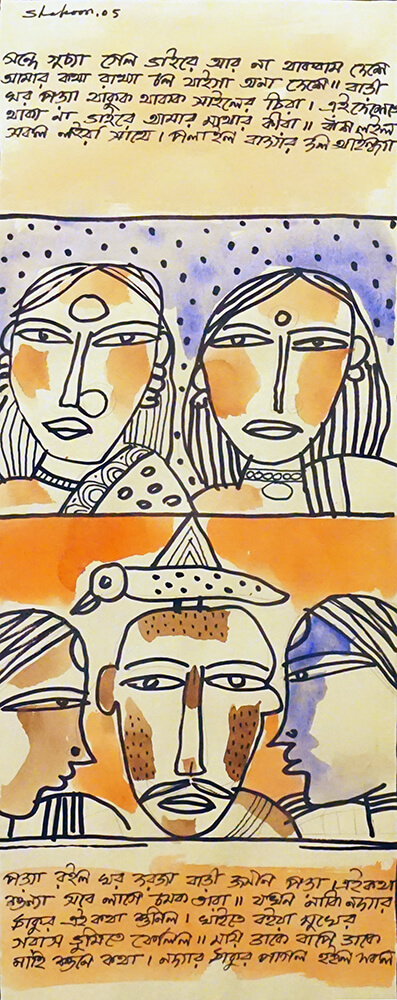
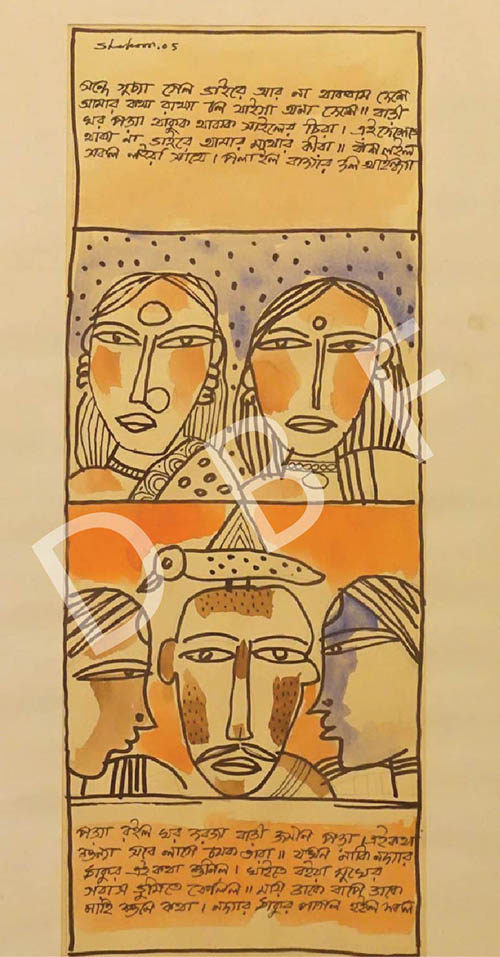
Abdur Shakoor Shah recreated the time-honoured love story of Mahua and Malua in his series “Mahua”. In this work, he uses folkish motifs with vibrant colours to put the ballad on paper. This 2005 painting goes by the same name and tells us a part of the story that is closely connected with our culture and heritage. Shakoor develops his imagery by applying thick drawing to lend the characters an almost naive look, outlining them to bring out their features in an informal manner. This painting allows a glimpse into the tale of love and illusion which the artist has tackled over the years in oil, acrylic and watercolour to express his allegiance to the ethos that have been preserved in folktales of the Bengal delta. Composed between the 16th and 18th centuries, the ballads are a reflection on social life and power relations in pre-modern Bengal, in which the female character is often plays a central role. This work, where colour is used sparingly, is an ode to Mahua, whose story has appeal across generations.

Abdus Shakoor Shah
Born in Bogura in 1946, Abdus Shakoor Shah is a renowned artist who gained prominence for his works on local lores and a style that straddles the line between traditional and modern inheritances. He obtained his bachelor’s degree in 1970 from the Government College of Arts and Crafts, now Faculty of Fine Arts, University of Dhaka. He later completed his post-diploma in fine art from the M S University of Baroda, Gujarat, India, in 1978. At Baroda, Shakoor was deeply influenced by the ideas of K G Subramanyan, an artist and teacher whose emphasis was in contextual practice. Shakoor joined as a faculty in Dhaka’s College of Arts and Crafts in 1970 and served as chairman of the craft department from 2003 to 2006. Among his many awards notable are Lalitkala Academy Award (1977) at Trienniale-India; the Excellence Award, Tokyo (1991); Diploma Uczestnictwa, Poland (1993); Honourable Mention Award in the 13th National Art Exhibition, Dhaka (1998), Gold Medal in 15th National Art Exhibition (2002), Dhaka, Bangladesh. Tokyo ACCU competition runner up prize (1998, 2000); Gold Medal in the 15th National Art Exhibition, Bangladesh Shilpakala Academy (2002); UNESCO and Civitella Ranieri Foundation Fellowship, Umbria, Italy (2006) and S M Sultan Padak (2008). Abdus Shakoor Shah continues to teach at the Faculty of Fine Art, University of Dhaka.
Mahua
Art Style
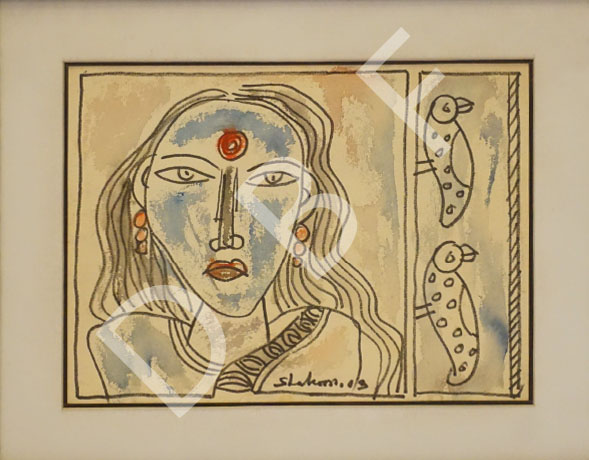
In his paintings, Abdus Shakoor Shah’s main preoccupation is working on Bengali ballads extracted from what came to be known as Mymensingha Geetika, a compendium of folk ballads. His work is a complex exploration of metaphors, cultural nuances and meanings associated with folklore. As a modern artist who seeks to attain an indigenous quality, he has steadfast in his re-construction of a forgotten chapter of history, the ballads that constitute the intangible heritage of the delta’s most fertile region – Mymensigh. Shakoor’s depictions work as visual cues to the story, and they tastefully bring the textual aspect of the folktale to the visual mode of expression through careful calibration of colour and form. For over five decades, Shakoor has been persistently experimenting with newer ways to externalize the story, and he continues to use many lines from the stories, sometimes turning his paintings into readable artworks. Colour and form together harness the rural flavour he seeks to attain. In terms of the composition, he sometimes follows the traditional pata where stories are drawn in rectangular segments. In Shakoor’s domain, only the bare essentials are brought to existence, sometimes employing a few lines to give shape to a chosen aspect of the ballad.
Gallery

Size: 40 X 40 inch
Year: 2000
Size: 11" X 14 ½" inch
Year: 2003

Size: 22X 11 inch
Year: 2002

Size: 11" X 14 ½" inch
Year: 2003
Title: Mahua
Size: 27.5 X 11 inch
Year: 2005

Title: Sufferer
Size: 13 ½X 10 ½" inch
Year: 1993