
“Battle over Shoal” is a 1990 oil on canvas by the master painter S M Sultan who had been living in his native village since the early 1950s till his death. Through his paintings he had developed a narrative of a coming society where the peasantry would own their own land. The contested idea of ownership has been a primary concern for the multitude who have been eking out a living from farming in the Bengal delta since time immemorial. Sultan has inserted into his landscape the idea of ownership to bring into view the fact that the peasantry in Bangladesh has been deprived of their rightful ownership though it is them who till the land to produce the staples. This late painting consists of the usual motifs of robust peasants who have waged a battle to take over the newly emerged sandbar. The artist always had the habit of representing a time that predated colonial rule, hence the spears carried by the muscled men. The organic life that Sultan was witness to, one which began to erode under modernism was also central to the artist’s vision. In this work, Sultan unveils the desire of the multitude whose life depends on the crop cycle.
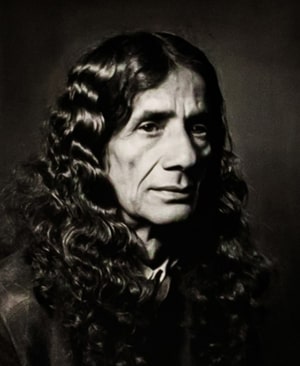
SM Sultan
Sheikh Mohammad Sultan, popularly known as S M Sultan (1923-1994) was a renowned painter celebrated for his visionary depiction of muscular Bengali peasants. Born in Machimdia of Narail district, Sultan’s artistic journey began when he was a child. He was inspired by his father’s masonry work. Young Sultan secured financial support from the local zamindar to continue his study at the local school. He later went to Calcutta (now Kolkata) to pursue art education. Though he did not meet the entry requirement to enroll in the art course at the Government School of Art, Sultan was allowed admission at the behest of Hasan Shahid Suhrwardy, the poet and art critic who became his local patron. He dropped out of art school after four years in 1944 and began touring across India making sketches of landscapes. He had his first solo exhibition in 1946 in Shimla, India. He had two more exhibitions in Lahore and Karachi, respectively in 1948 and 1949 after Pakistan came into being following the partition of the subcontinent. He travelled to America and Europe only to have returned to his native village in 1953. His first major solo exhibition was held in Dhaka at the Bangladesh Shilpakala Academy in 1976, which shaked up the status quo in the country’s art circle. A second wave took place when the German Cultural Centre organized his solo exhibition in 1987. Sultan’s work is characterized by its decolonial themes and like fables they have protagonists in the form of robust ,muscular figures, reflecting the strength of the bhumiputra, or the man of the soil. His communal vision centred on the peasantry, their ownership of land and the life lived in communion with nature found its proper expression after Bangladesh came into being in 1971. He received Ekushey Padak in 1982 and Swadhinata Padak (Independence Award) in 1993.

Char Dakhal, or Battle over Shoal
Art Style
As one of the figurative exponents of the first generation, S M Sultan developed an oeuvre based on his vision of a community where everything is shared equally by the protagonists – the peasants. In his work the “rural” unfolds as the “primal location” where community members live as one with nature. To sum up his style, his philosophy to lend primacy to Bangladesh’s vast majority of people who live off the land and also produce the staple for the multitude as the main actors in the agricultural sector needs to be taken into account. At the centre of Sultan’s discourse of a coming society lay the idea of a pre-colonial egalitarian life lived in harmony with nature. To empower the peasantry he envisioned muscled men and women who have a shared vision to live and let others live bound by the ethos of collectivism. His figuration can thus be considered a way for him to capture the primal scene, where Adam and Hawa (Eve) and their sons and daughters are engaged in the making of an egalitarian community. The murals of Ajanta and Elora cave and those of the Sistine Chapel collide in most of his masterpieces where men and women are engaged in their day-to-day tasks.
Gallery
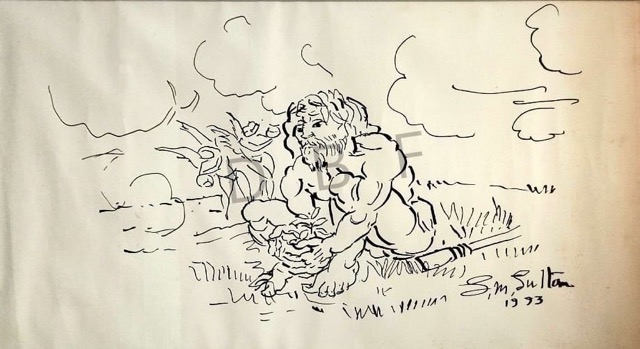
Size: 22.5 X 35.5 inch
Media: Sketch on Paper
Year: 1993
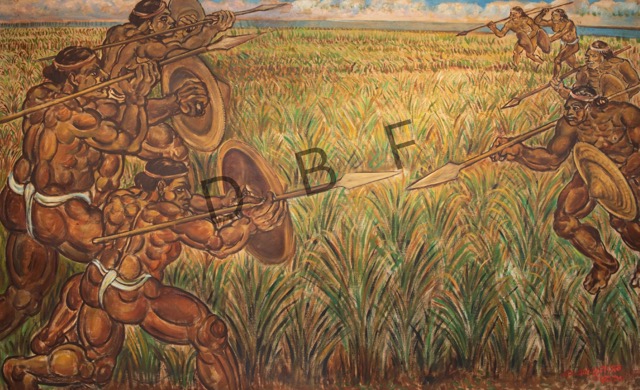
Title: Chor Dokhol
Media : Oil On Canvas
Size: 81.5 X 50 inch
Year: 1990
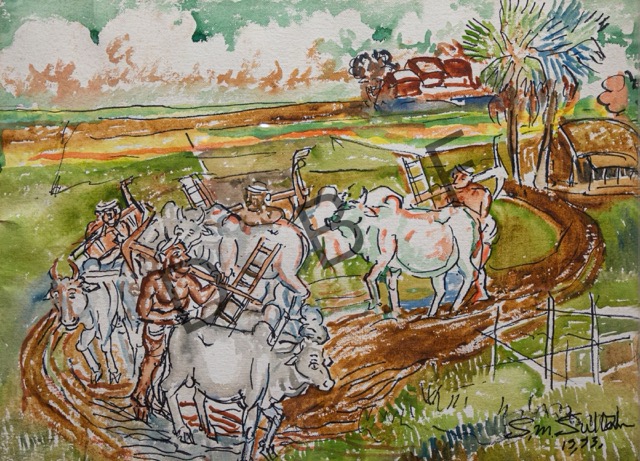
Size: 29.5 X 21.5 inch
Year: 1993
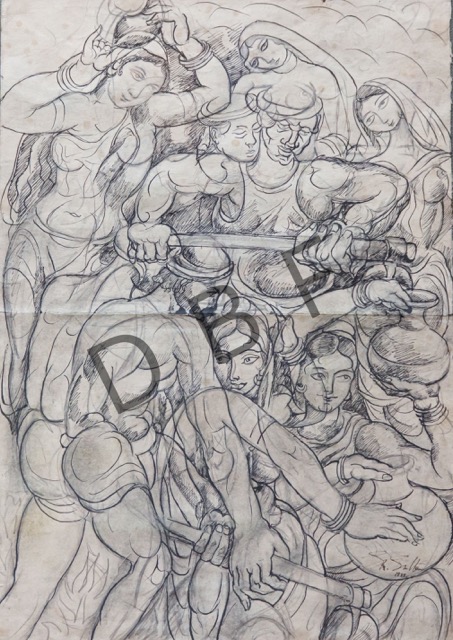
Title: Harvesting
Size: 20 X 15 inch
Media : Pen and Ink on paper
Year: 1977