
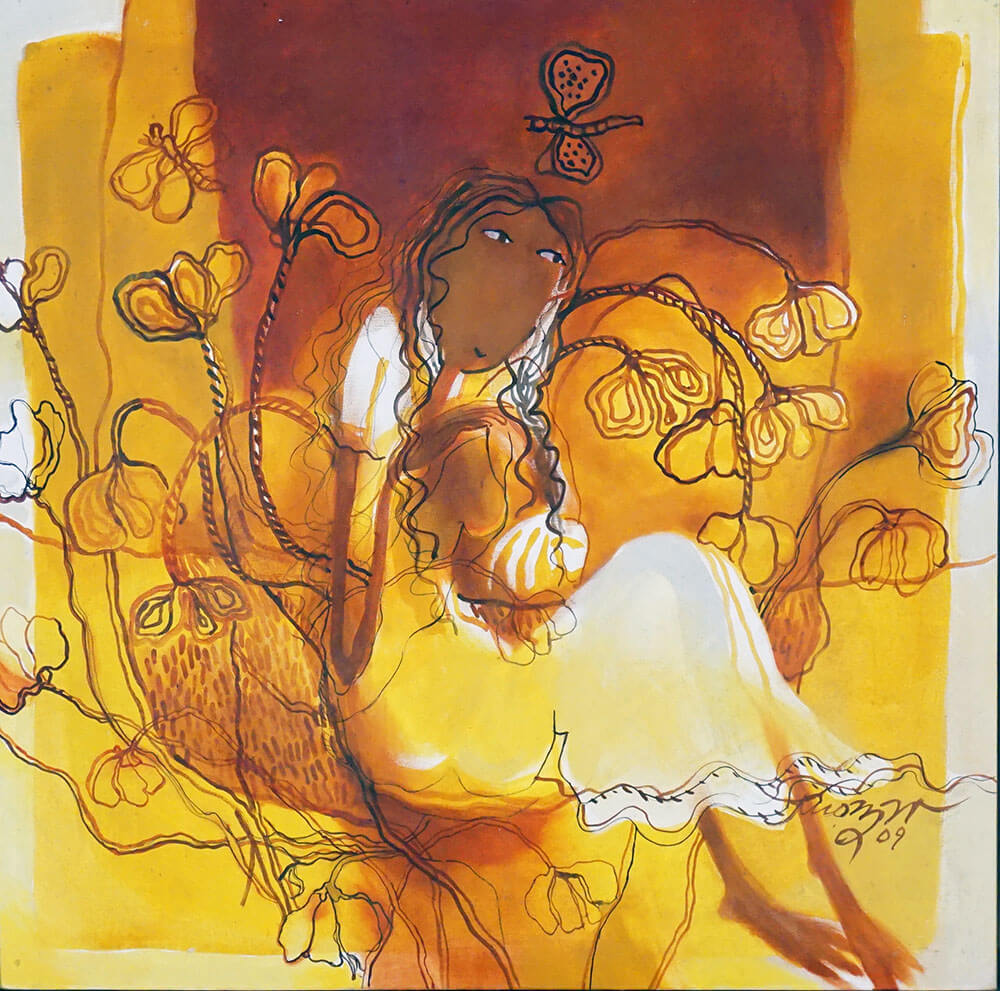
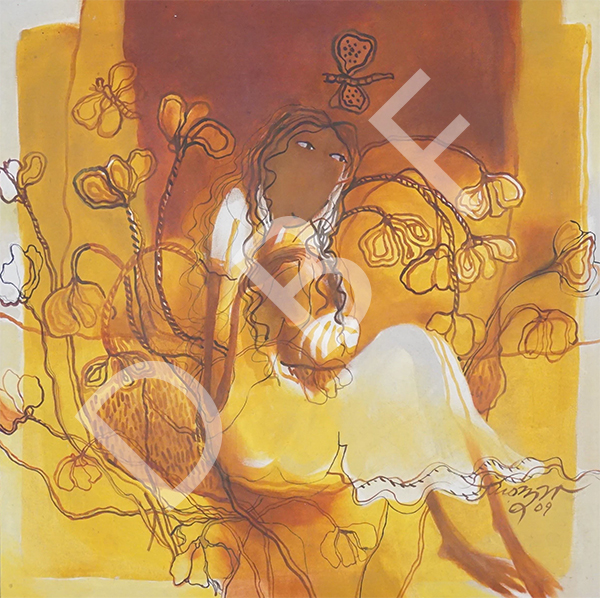
“Autumn-3” is a 2007 acrylic-on-canvas painting by Farida Zaman. She uses warm yellow, a bit of orange and burnt sienna to create the festive atmosphere of Autumn to celebrate womanhood amid botanical references. Autumn comes with its bright clear sky, golden paddy fields, and signals the arrival of the goddess Durga. The celebration that starts with the welcoming of the deity Durga continues till “Nabanna”, the annual harvest festival. Nature’s glory is thus mythified in this region. In the hand of the artist the myth has been rendered earthy, as the Bengali damsel represent the bounty that this season offers to the people who plough the land and sow the seeds. Farida Zaman paints with her face towards the local motifs. In this work, the lines emulate the botanical elements, expressing the eternal bond between nature and humans.

Farida Zaman
Farida Zaman was born in Chandpur, Bangladesh, in 1953. She graduated from the College of Arts and Crafts in Dhaka in 1974. She received her master’s degree from the M S University in Baroda in 1978, and then went on to receive a doctoral degree from Visva Bharati, Santiniketan, West Bengal, India, in 1995. Her days at Santiniketan, spent under the tutelage of K G Subramaiam, were foundational to her current practice. Her learnings amid nature set the tone for her artistic vision. Farida Zaman’s works have been widely exhibited and they bear the signs of how she internalized the realities of this deltaic region where water is the predominant element that governs over all life forms. Notable among her awards are the Commendation Award at the 5th edition of the Triennale-India (1982), the Australian government’s Cultural Award (1985), the National Book Center Award for Children’s Book Illustration (1986), the International Life Membership Award of Salon de Tokyo, Japan (1986), the Bangladesh Mahila Parishad Award (2009), and Sultan Padak (2020). For her contribution to art, she was conferred Ekushey Padak in 2020. Farida Zaman is a professor at the Department of Drawing and Painting, Faculty of Fine Arts, University of Dhaka.
Autumn - 3
Art Style
Farida Zaman became well known for her early forays in which she began to depict the riverine life of Bangladesh. Throughout the late 1970s till the 1990s, her primary reference was fishing nets. In the manner of all-over paintings she has been constructing panoramic views of the water world – the countryside thus has been recreated through the specific use of motifs of small fishes scattered across a net. The use of earthy tone as well as the watercolour-like treatment of the surface of the canvas made her images look more contextual than those of her contemporaries. She gradually began to introduce doll-like women, cats and birds to give a sense of an ecology where species share the same environment, sustained by the same deltaic rivers responsible for making the soil fertile. Through her paintings Farida Zaman lends salience to the ecological reality of the delat, besides re-emphasizing the place of women in nature and in society.
Gallery

Artist: Farida Zaman
Dimension: 15″ X 10″
Year: 2006
Title: Autumn- 3
Media: Acrylic on Canvas
Year: 2007