
Hashem Khan’s “Season-Rainy” brings into view the essence of the rainy season of this country of six seasons. He painted the sky covered with thick layers of clouds rendered in blue brushworks, which is his way of lending painterly quality to his subjects. In this work the world is seen through the eyes of a person who awaits a rainy day and thrives in the pleasure of looking at the clouds and the pouring rain. Instead of plumbing the gloomy disposition and passive reaction to a rainy day, the painter captures the joyful state associated with rain. Hence the colour yellow, orange and green – a spectrum of colours associated with a sunny day. In this 2002 painting, he celebrates the rainy season of this riverine delta. He welcomes the rain and like the peasants of the land he too looks forward to a better harvest that timely rain may ensure. Rainfall is the lifeblood of agriculture, dictating the rhythm of the rural economy. “Season– Rainy” is thus Hashem Khan’s symbolic acknowledgement of the country’s lifeline – the water that is heaven-sent and gives nourishment to the vast cropland as well as making its river system come alive. It is a testimony to the amazement he feels looking at the bounty of nature.
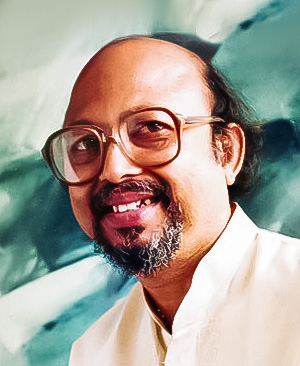
Hashem Khan
Born in 1941, Hashem Khan is one of the prominent artists whose engagement in fine art and the publishing sector have enriched these two respective fields. He graduated from the Government College of Arts and Crafts (now Faculty of Fine Arts, University of Dhaka) in 1961. He later received training in book design and illustration from Asia/Pacific Cultural Centre for UNESCO, Tokyo, in 1979. He served as a teacher at the Faculty of Fine Arts for 44 years and retired in 2007. Hashem Khan is a founder member of the Dhaka City Museum. His contribution to the cause of children is widely recognised. He has also authored several books. As a painter he has gained wide recognition. Like many of his contemporaries, he also turns to rural Bangladesh for his inspiration to ensure that his modern practice is not forgetful of the life and culture of the vast majority. Through his paintings, he also recalls the memory of the Liberation War, often treating the canvases with subject matters that serve as a reminder of both the sufferings of the multitude during the war and the joy of freedom after Bangladesh came into being. Hashem Khan received Ekushey Padak in 1992 and Independence Day Award in 2011. A freelance artist and social activist, Hashem Khan lives and works in Dhaka.
Season - Rainy


Old Dhaka - 2
“Old Dhaka-2” is a 2003 watercolour painting by the veteran artist Hashem Khan. He captures the old world charm of Dhaka in all its earthy tones. In this work, where the illustrative elements easily meld with painterly gestures, his lived experience twines with the emerging modern trends of development that threatens to efface the old characteristics of the city. Among the hustle and bustle and the race for a better life, Old Dhaka remained unchanged for a long time with its distinct social ethos, worn out edifices of traditional buildings. However, that life and the architectural landscape rooted in history is now under threat of extinction. His painted local carriage, old mosque and the eyes that had experienced that picturesque past can serve as a trigger for memory. Old Dhaka-2 is his nostalgic homage to a city that shaped him as an artist. He has illustrated his emotions, dreams, and memories attached to it in the most delicate way possible.
Artist Art Style
Hashem Khan’s vision has evolved within the developing nationalist narrative linked with the political upheavals of his time. He was born in 1941 in Chandpur, Bangladesh. The quaint rural setting that fed the young Hashem Khan’s imagination remained with him. The painter who would later spend a large part of his time and energy in illustrating children’s books and ensuring art education for children, has also brought to the fore an array of images through which he has memorialised the Liberation War and paid his homage to the rural beauty, amid which he had the opportunity to grow up as a child. He belongs to the school of painters who avoided being trapped in categories such as abstraction and figuration so that a third way can be found to advance the cause of what many have dubbed as “indigenous modernism”. Like many of his contemporaries, he too has been drawing his inspiration from life in rural Bangladesh and the politics of indigeneity associated with the social and cultural movements in the country.
Gallery
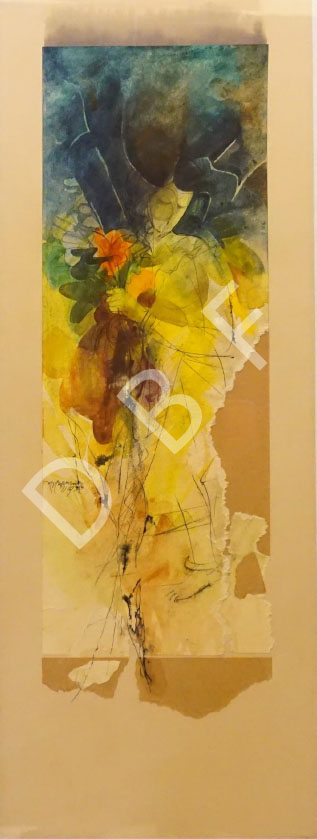
Year: 1997
Size: 41.5 X 15 inch
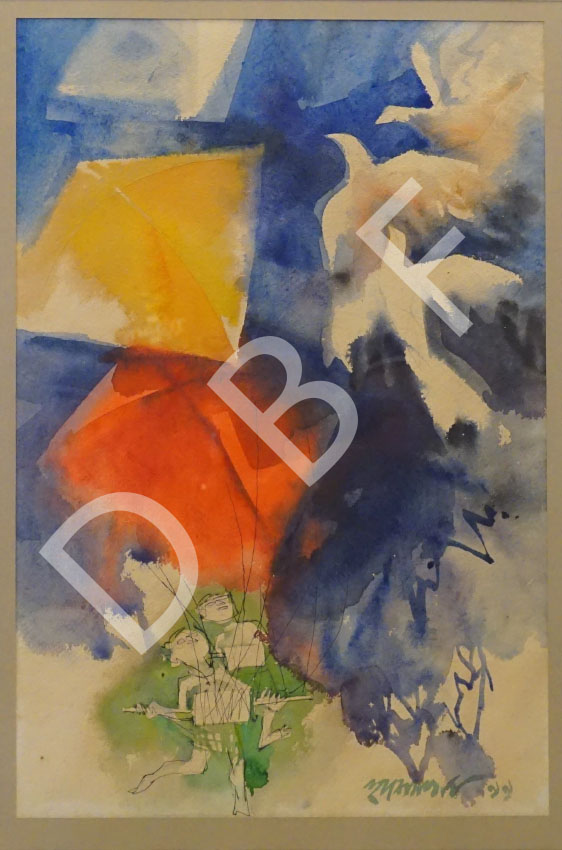
Tittle: Ghoori
Year: 1999
Size: 22.5 X 15.5 inch
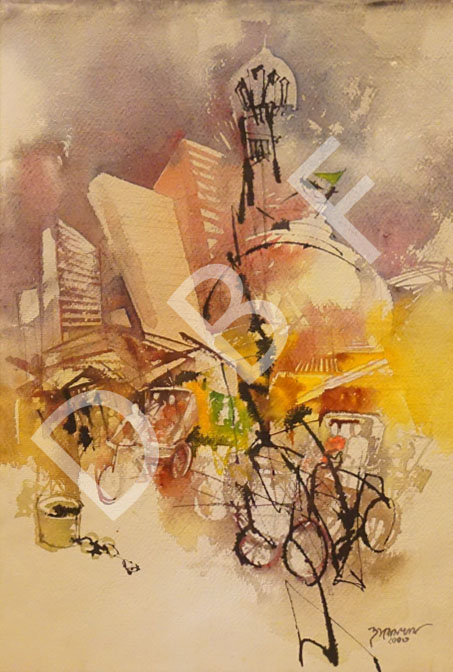
Title: Old Dhaka-1
Year: 2003
Size: 21.5 X 14.5 inch
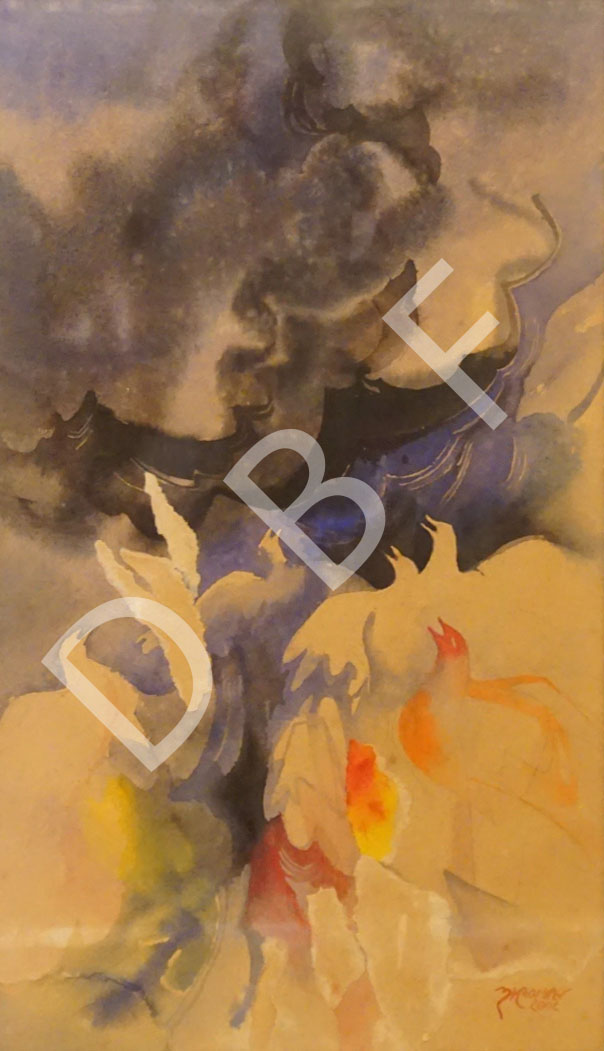
Year: 1997
Size: 41.5 X 15 inch
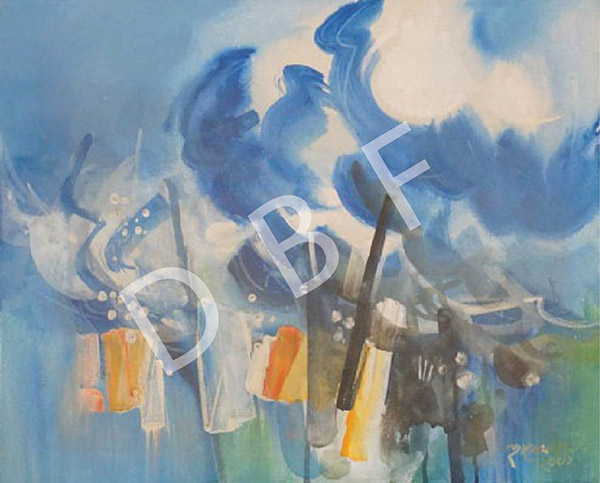
Title: Season-Rainy
Year: 2002
Size: 18 X 22 inch
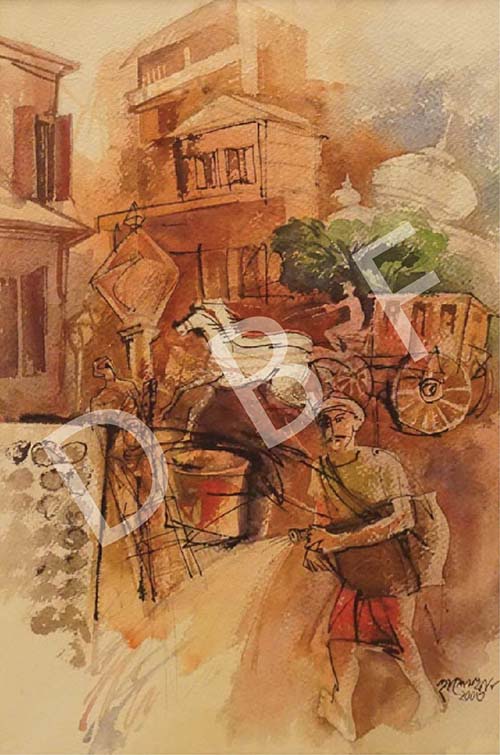
Tittle: Old Dhaka-2
Year: 2003
Size: 21 X 14 inch