
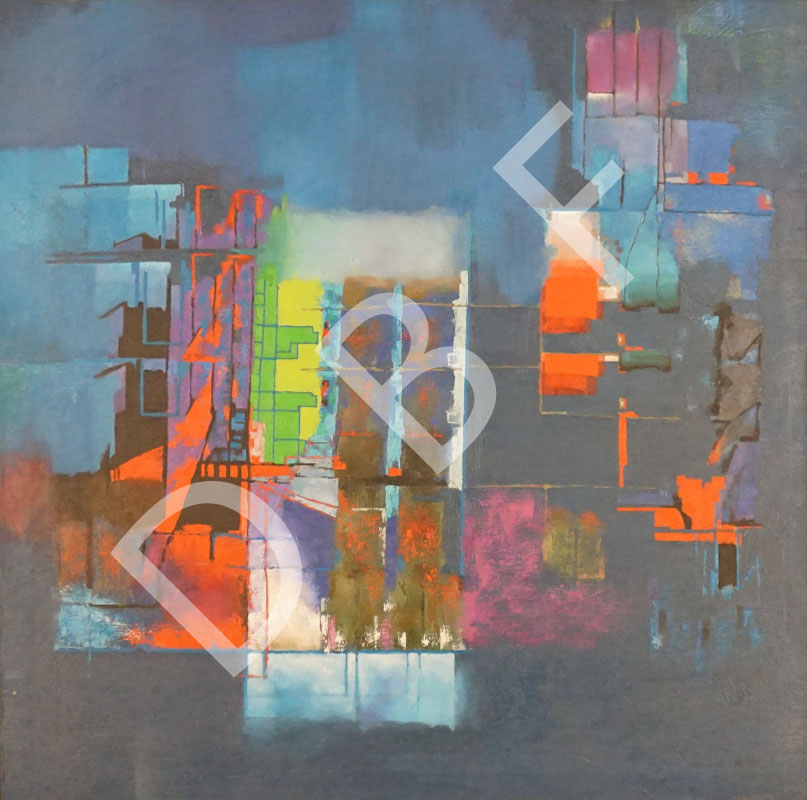
Nitun Kundu’s life and work testify to his allegiance to the abstract art movement of the 1960s. This work is representative of his late style after he returned to painting to celebrate the freedom that he could associate with abstraction and the independence of his country in 1971 following a nine-month-long war. Throughout his career, the Liberation War remained a recurring theme, through which he continued to give shape to his aesthetic desires. In this 2005 acrylic on paper, Nitun Kundu captures his emotion that accreted around the emergence of a country that has had a fair share of its political upheavals over the years, though never at the expense of the sphere of hope this new country has created among the multitude. He uses a palette where seemingly disparate colours are juxtaposed to create harmony among the visual elements. The all-pervading blue against which yellow and orange stand out together create a unique colour-field onto which the dancing lines are etched. This multi-planed spatial construction gives a feel of a virtual landscape.

Nitun Kundu
Nitya Gopal Kundu, widely known as Nitun Kundu, was a painter, designer, sculptor, and industrialist. Born in Dinajpur on December 3, 1935, Nitun Kundu completed his graduation in art in 1959 from Dhaka’s Government College of Art and Craft (now Faculty of Fine Arts, University of Dhaka). In the years leading up to 1971, he worked at the United States Information Service (USIS) in Dhaka designing exhibitions and visual materials. In 1975, following a brief stint at Bitopi advertising agency, Kundu established his own company, a furniture company Otobi, featuring his designs. He was part of the abstract art movement that dominated the art scene in the 1960s. He held four solo exhibitions in Dhaka (1965, 1966), Chittagong (1966) and Rajshahi (1968). He also participated in many national and international art exhibitions from 1956 to 2001. His creativity flowed in many directions, including furniture design and outdoor sculpture. He is well known for his early abstract composition he used to develop with metal. Among the sculptures in public places two of the most enduring symbols are “Mother and child” (1975) and “Sabash Bangladesh” (1992), a Liberation War memorial at Rajshahi University. Nitun Kundu received Ekushey Padak in 1997. His last participation in a group event was in June 2006 at the Dhaka Art Camp at Savar, organized by Bengal Foundation. He died of old age complications on September 15, 2006.
Cityscape

Art Style
The Liberation War was the inspiration behind Kundu’s most famous work, the sculpture Shabash Bangladesh, situated on the campus of Rajshahi University, a tribute to the muktibahini members or freedom fighters who laid down their lives during the course of the nine-month-long war that finally gave birth to Bangladesh. Since his engagement with furniture industry and other industrial design, his paintings remained a less-talked-about subject. However, in his early years in the 1960s as well as late in his life, he explored abstraction through a lens effectuated by his affinity with colours and patterns he had the knack to develop through the application of intersecting lines. In the fine art arena, his works are as diverse as they are in industrial design. He designed many trophies, crests, and medals for national-level prizes and awards, including Ekushey Padak, National Film Award, President Gold Cup and Asia Cup cricket prizes, Natun Kuri award for BTV, and International Trade Fair, President’s trophy for children’s football, etc. He demonstrated skill in designing pavilions, gates, stages, decorative lighting as well as posters and logos. His multi-faceted talent has seen its application across disciplines.
Gallery

Title: Cityscape
Size: 36 X 36 inch
Title: Untitled
Size: 36 X 36 inch

Title: Untitled
Year: 2005
Size: 24 X 36 inch
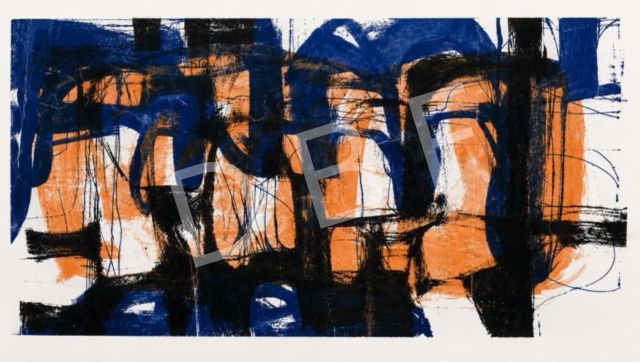
Title: Crystals
Size: 11 x 21.5 inch
Media: Linocut
Year: 1963